I've been spending a lot of time thinking about how technology is changing our world, and what impacts that will have on the presentation and delivery of education. Here is an outline of some of my recent thoughts:
Customization
Technology is changing our reality, and we are starting to expect the world around us to react to our needs. Consider:
A. Walmart -- Much has been written about the marketing giant. And a lot of the press focuses on how Walmart is crushing small retailers, exploits its workers, and all sorts of other negatives. All of which may be true. Walmart also has a very efficient supply chain, where they try to move products directly from the manufacturer to the customer, with little or no time in warehouses or on store shelves. They work very hard to offer the customer the lowest price possible, and are constantly working to lower prices further (check out their current pressure on the recording industry for sub-$10 CDs.) They do this (and make a lot of money) by being very good at predicting what people will want, and when. The result is when I walk into a Walmart, if everything is working properly, they will have not only the items I want, but items I didn't remember I needed. And in fact one of the top complaints from Walmart customers is that they end up walking out with more items than they intended on buying. The environment is anticipating and responding to my needs!
B. Dell Computers -- Again a very efficient manufacturer, almost no warehousing, and very good information systems. When a customer calls to place their order, the computer they are purchasing doesn't exist. For an order placed at 8am, Dell assembles the parts, builds the computers, and has it packed in a box, on the loading dock by 2pm the same day! Again a quick response to my individual needs and desires for what my computer should be.
C. Amazon.com -- Amazon is a special case, as they fit into my thoughts at several different levels. In the role of customization, they develop a profile of my buying preferences over time. Based upon my past buying behaviors, the Amazon.com store adapts to me. So when I connect to the store the selections I see are different than when my wife connects. Amazon responds one way to me, and another way to her. By the way they have patented this technology, and it is seen as a key advantage over their competitors. It must be working.
These are just a couple of examples of commercial enterprises that are using technology to efficiently get us the items we want (or need), when we want and at a price that beats their competition. They don't always get it right, but their success and continuing growth show that they are meeting our needs. The fundamental effect is that our perception of the world is being changed. We are starting to live in a world -- at least when in one of their segments of the world -- that anticipates and responds to our individual desires.
Two other areas that I see in this technological world change are socialization and information context. I'll write more about them in later posts.
1/25/2005

Networks -- Part 2
Here is a little more on the Science of Networks. These points stuck with me:
The Internet is not randomly formed. If it was, most nodes, or websites, would have a similar number of connections to other nodes. But the Internet has connectors, a relatively small number of nodes that have a large number of connections to other nodes. Most nodes have few connections, but these few have many. This is often described as the 80:20 rule. 80% of the links are held by 20% of the nodes.
When networks form, new nodes are constantly added. As they make connections, they have a preference for nodes that have the most connections. The rich get richer... In a social setting these are the popular people in the room. There is a "fitness" factor for nodes that can result is a new node rapidly accumulating connections, and even usurp the connector status of existing nodes. The ideas that the web is a great democracy, where any website can complete with any other is simply not true.
Networks can be directional, where the connections are one-way only. This is exhibited on the Internet. My website may link to your website, but yours probably doesn't link to mine. This affects the software robots used by the search engines (google, etc.) to index websites. They end up only being able to index about half the web. These robots start at a connector website, somewhere in the middle of things. They can swim downstream, but can't get upstream.
These revelations only really started to be understood in 1999. And our understanding of how the Internet forms, grows, and changes over time is still evolving (as is the web.) Once these principals were see in relation to the Internet it started to become clear that other networks, from cell structures to economic markets exhibited similar behaviors.
A great read -- well worth the time, and the audio book is well done.
Albert-László Barabási's book, Linked: The New Science of Networks
The Internet is not randomly formed. If it was, most nodes, or websites, would have a similar number of connections to other nodes. But the Internet has connectors, a relatively small number of nodes that have a large number of connections to other nodes. Most nodes have few connections, but these few have many. This is often described as the 80:20 rule. 80% of the links are held by 20% of the nodes.
When networks form, new nodes are constantly added. As they make connections, they have a preference for nodes that have the most connections. The rich get richer... In a social setting these are the popular people in the room. There is a "fitness" factor for nodes that can result is a new node rapidly accumulating connections, and even usurp the connector status of existing nodes. The ideas that the web is a great democracy, where any website can complete with any other is simply not true.
Networks can be directional, where the connections are one-way only. This is exhibited on the Internet. My website may link to your website, but yours probably doesn't link to mine. This affects the software robots used by the search engines (google, etc.) to index websites. They end up only being able to index about half the web. These robots start at a connector website, somewhere in the middle of things. They can swim downstream, but can't get upstream.
These revelations only really started to be understood in 1999. And our understanding of how the Internet forms, grows, and changes over time is still evolving (as is the web.) Once these principals were see in relation to the Internet it started to become clear that other networks, from cell structures to economic markets exhibited similar behaviors.
A great read -- well worth the time, and the audio book is well done.
Albert-László Barabási's book, Linked: The New Science of Networks
1/24/2005
Studying Networks
I've been working my way through the audiobook version of Albert-László Barabási's book, Linked: The New Science of Networks . Pretty cool stuff, and surprising how recently we have started to understand how complex networks, like the Internet, come to be. Barabasi manages to range his examples from the rise of early Christendom to the six degrees of Kevin Bacon, to understanding how the Internet forms. The discussion is a little dense at times, but overall there are a lot of really interesting concepts. I have read nothing of network theory up until now, so it was a real eye opener, and gives me a new perspective to how the networks that make up our world function.
The OPTE project is working to create visual representations of the Internet. Here is one of their latest images -- looks alive, doesn't it?

http://opte.prolexic.com/maps/
1/23/2005

Ethan and I took a walk this morning and here is what we saw! Check out the rest of our walk in our new flickr page.
1/19/2005
Keeping the media honest with podcasting

This is an interesting article on several levels. First this is a commentary based upon an interview with UserLand Software CEO Scott Young. That interview is offered as part of ZDNet's podcasts, and the article references the time code of the interviews mp3, so the reader can cross reference what Young actually said with the representation in the article. A very interesting way to offer several layers of information.
And the article itself is also pretty cool. They talk about the value of RSS for keeping track of all sorts of content. Sure, using it for weblogs is pretty good. I recently experimented with using Web Collaborator for a couple of group projects. The killer feature was an RSS feed for each collaboration. I just added each project to my daily RSS feeds, and it was really easy to keep up with the latest posts. I saw a recent reference to an RSScalendar, but the website wouldn't load for me. I'll check it out later, but the concept seems like it could be really useful.
Book References
I have mentioned several books over the last several weeks. Here are some links to find out more about them on Amazon.com
Rushkoff: Playing the Future
Malcolm Gladwell's books
Society of the Mind cyberthriller
And this'll give me a chance to try the Amazon associates program.
Rushkoff: Playing the Future
Malcolm Gladwell's books
Society of the Mind cyberthriller
And this'll give me a chance to try the Amazon associates program.
1/18/2005
What is a Folksonomy
It may be the next new word for Webster's dictionary. For a definition take a look here:
IAwiki: FolksOnomy
And for more discussion of this point here is an interesting discussion at Verderwal.net
I saw a great article the other day discussion the folksonomy idea, particularly as it displayed on sites like del.icio.us and furl. Its listed in my FURL archive, which you'll find in the right-side column. Basically the concept is that there are (at least) 3 ways to index information -- have professionals do it (librarians); had the content creators do it; or have readers do it (folks.) And it seems that having the folks do it can have some pretty significant advantages. Its a very interesting discussion.
IAwiki: FolksOnomy
And for more discussion of this point here is an interesting discussion at Verderwal.net
I saw a great article the other day discussion the folksonomy idea, particularly as it displayed on sites like del.icio.us and furl. Its listed in my FURL archive, which you'll find in the right-side column. Basically the concept is that there are (at least) 3 ways to index information -- have professionals do it (librarians); had the content creators do it; or have readers do it (folks.) And it seems that having the folks do it can have some pretty significant advantages. Its a very interesting discussion.
Experimental Warning -- Proceed with Caution

Here is the idea from A List Apart (I love this website.) Add a warning when you are experimenting with some new web technology to let viewers know that they may hit some bumps.
I have often used my personal websites to showcase new, cool, experimental stuff, and saved the boring stuff for the "real" websites. But sometimes I just get fed up with trying to make my website work for all audiences, and just design to stimulate the senses, standards be damned! And now when frustration hits I'll just post the warning label. Maybe even include a special opt-in warning, like the over 21 age opt-ins that appear before viewing "adult sites" (not that I'd know about those things.)
1/17/2005
The Read/Write Web
I caught a great Podcast today at IT Conversations with Doug Rushkoff. You can hear it yourself at IT Conversations: Doug Rushkoff - Renaissance Prospects . I wrote about Rushkoff's book, Playing the Future, a couple of weeks ago. This talk, as with the book, raised a lot of interesting, thought provoking points. I do think that Rushkoff sometimes takes his points to an illogical extreme, but the ideas themselves ring very true.
This graphic is a must view as you listen to the talk.
The talk is far ranging, starting with a comparison of the parallels between the Renaissance and the current information renaissance. He goes on to discuss the growing control we have over our information environment through hypertext (relate anything to anything else) and ability to truly work with others, share information, and shape our view of the world. We are no longer "passive recipients of stories" but "active participants" in making these stories. His point reminded me of Tim Berners Lee's original vision of the world wide web from the early 90's:
The web was to be “ a common information space in which we communicate by sharing information. A Hypertext link can point to anything, be it personal, local or global, be it draft or highly polished.” And “ second, a realistic mirror of the ways in which we work, play, and socialize…We could then use computers to help us…make sense of what we are doing… and how we can better work together.”
Maybe Tim really did know what he was doing -- its just taking a while for the rest of us to catch up. Rushkoff goes on in his talk to question the whole concept of a market driven economy -- and you know, he makes a pretty persuasive argument.
This graphic is a must view as you listen to the talk.
The talk is far ranging, starting with a comparison of the parallels between the Renaissance and the current information renaissance. He goes on to discuss the growing control we have over our information environment through hypertext (relate anything to anything else) and ability to truly work with others, share information, and shape our view of the world. We are no longer "passive recipients of stories" but "active participants" in making these stories. His point reminded me of Tim Berners Lee's original vision of the world wide web from the early 90's:
The web was to be “ a common information space in which we communicate by sharing information. A Hypertext link can point to anything, be it personal, local or global, be it draft or highly polished.” And “ second, a realistic mirror of the ways in which we work, play, and socialize…We could then use computers to help us…make sense of what we are doing… and how we can better work together.”
Maybe Tim really did know what he was doing -- its just taking a while for the rest of us to catch up. Rushkoff goes on in his talk to question the whole concept of a market driven economy -- and you know, he makes a pretty persuasive argument.
1/16/2005
Blogging and Newsfeeds
At PodcastTools you'll find some very well done videos that walk you through the process of starting your own blog on blogger. When you get to the page scroll down to THE TRAINING section. There you'll see the first one is how to set up your free blogger account.
Not ready for a blog? Well, why not create your own customized homepage. It costs you nothing except a little time, and take it from me -- it is a worthwhile investment. I use Yahoo's MY YAHOO page. I think you can just click on that link on the right where is says my yahoo. The MY YAHOO page is great, as you can customize it with local weather, comics, and most importantly, see the Newsfeeds from your favorite Blogs and other sources. It is the easiest and quickest way to start experimenting with the power of NEWSFEEDS!
Not ready for a blog? Well, why not create your own customized homepage. It costs you nothing except a little time, and take it from me -- it is a worthwhile investment. I use Yahoo's MY YAHOO page. I think you can just click on that link on the right where is says my yahoo. The MY YAHOO page is great, as you can customize it with local weather, comics, and most importantly, see the Newsfeeds from your favorite Blogs and other sources. It is the easiest and quickest way to start experimenting with the power of NEWSFEEDS!
1/15/2005
Catch the Podcasting bug!
I am loving the new I-pod, and am really getting into the whole pod-casting thing. And I'm not the only one. I copied a bunch of Adam Curry's podcasts onto CD for my neighbor Sean to listen to. And he loved it! He's hooked. And is now eyeing the I-pod with renewed interest. I think there may be one in his future, or at least some type of portable mp3 player. The whole this is still kind-of geeky, but it is also a great way to distrubute content. I think I might make the leap and am kicking around a couple of ideas.

E - tunes -- with our own Ethan as the model -- plugged in and ready to Podcast.
Podcasts are not live, and they are not radio. I thing of it more like books-on-tape, or maybe magazines on tape. Its sort of like I can create my own audio magazine, made up of the content that I want to hear. Learn more at podcast.org where you'll find listings of available podcasts and information on getting yourself plugged in.

E - tunes -- with our own Ethan as the model -- plugged in and ready to Podcast.
Podcasts are not live, and they are not radio. I thing of it more like books-on-tape, or maybe magazines on tape. Its sort of like I can create my own audio magazine, made up of the content that I want to hear. Learn more at podcast.org where you'll find listings of available podcasts and information on getting yourself plugged in.
1/12/2005
Accidental Knowledge
I find that I most often make my web discoveries through a convoluted series of chance encounters. For instance, this evening while checking the latest RSS feeds I noticed this one concerning a new book by Malcolm Gladwell:
Scobleizer: Microsoft Geek Blogger
And it sounded pretty good. So I jumped to Malcolm's website and saw the book. But actually seeing as I am taking two graduate classes myself at the moment (I should be doing work for those now...) and teaching a couple of classes, I don't have much spare time for reading. So I decided to check and see if any of Malcolm's books were available as audio books. Which took me to Amazon, and I couldn't find anything. But somewhere in there (and now I forget where) I saw a reference to a recent speech given by Malcolm. Sounds good and I ended up at:
IT Conversations: New Ideas Through Your Headphones
Which is a totally cool site with a ton of interesting audio speeches. I grabbed the Gladwell talk and registered myself on the site. And I added them to my RSS feed listings in Feed Demon so I could keep up on their latest releases. And I was back where I started.
I find myself often jumping quickly from thing to thing. For instance after that little journey I clicked the BLOGTHIS link on my Firefox tool bar and started this entry. Now back to my RSS feeds, and then back to my on line course pages at Capella University (which weren't working 15 minutes ago when I started this whole thing!)
Scobleizer: Microsoft Geek Blogger
And it sounded pretty good. So I jumped to Malcolm's website and saw the book. But actually seeing as I am taking two graduate classes myself at the moment (I should be doing work for those now...) and teaching a couple of classes, I don't have much spare time for reading. So I decided to check and see if any of Malcolm's books were available as audio books. Which took me to Amazon, and I couldn't find anything. But somewhere in there (and now I forget where) I saw a reference to a recent speech given by Malcolm. Sounds good and I ended up at:
IT Conversations: New Ideas Through Your Headphones
Which is a totally cool site with a ton of interesting audio speeches. I grabbed the Gladwell talk and registered myself on the site. And I added them to my RSS feed listings in Feed Demon so I could keep up on their latest releases. And I was back where I started.
I find myself often jumping quickly from thing to thing. For instance after that little journey I clicked the BLOGTHIS link on my Firefox tool bar and started this entry. Now back to my RSS feeds, and then back to my on line course pages at Capella University (which weren't working 15 minutes ago when I started this whole thing!)
1/08/2005
Creative Commonists

Creative Commonists
Some recent comments by Bill Gates on the subject of less restrictive intellectual property policies has set off a flurry of comments in the web community. I must admit that I was at first skeptical of the importance of this discussion. But the more I learn, the more of a convert and advocate I become. This article from today's WIRED feed nicely sums up this current fracas:
We're Creative Commonists, Bill
Also be sure to pay a visit to the Creative Commons page, listed in my weblinks on the left side of the page.
1/05/2005
More Social Gaming
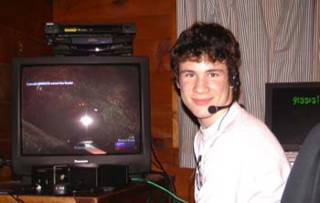
Leo LIVE on the brand new X-Box. He is exploring the virtual world of Halo 2 with his good friend John (a mile away in front of his own X-Box.) Ethan would be there too but he had to go to bed. Note that when we were in the game store earlier this evening Leo had absolutely NO interest in any other off-line games. He wanted to be on line with his friends. His motivation is not the game itself. The driving force behind his recent obsession with obtaining X-Box is the ability to share the game play with his other friends scattered around town.
The Thinking Computer
I picked up a stack of books a couple of weeks ago at our library book sale. My main goal was to support the library, so I just snagged books with interesting titles or nice cover art. And with a nice week off between xmas and the New Year I managed to work my way through them. There were a couple of duds, but also two nice surprises. Both deal with computers that become self-aware.
Exegesis by Astro Teller is modern take on an epistolary, but instead of letters the story is a series of e-mails. The story starts with an email from a computer program to the graduate students that created it. She is at first sure that someone is playing a practical joke. Edgar (the program) was designed to sift through Internet pages and compile summaries of the content. Somewhere is the process it became self-aware. It is also making posts to newsgroups and annoying people. Afraid that others will grab the glory before she can properly document her work, she disconnects the computer from the Internet. But it is designed to process information, and without the Internet to crawl through get bored. So it plans an escape, gets a technical to reconnect it late at night, and moves itself out to another computer on the Internet beyond Alice's control. Alice tries to replicate her program and create another self-aware Edgar, but without success. She can't make the magic happen. It was some random combination of elements that gave Edgar the spark to come to life.
The other book is Society of the Mind by Eric L. Harry. This is billed as a "cyberthriller" and lives up to its name. A Harvard psychology professor is offered a million dollars for a week-long consulting gig with Joseph Gray, the worlds richest and smartest man. She accepts (even in fiction Harvard doesn't pay that well I guess) and is whisked by private plane to his private Pacific island. Its a long involved story with all sorts of good action/thriller types of twists. But the main point is that Gray has built a massively parallel, analog computer that, again, becomes self-aware. The professor, Laura, is there to help the main computer with some emotional problems. Gray also has built some better models that are smaller (only 12' high) and mobile. The deal with these computers is that they aren't actually programmed. Once built they need to go through an involved conditioning process to teach them to walk, talk and interact with their environment.
The interesting thing here is that in both books the computers act so very human. They don't like to sit around with nothing to do. They don't like to be force-fed information and told what to do. The magic of their self-awareness was nothing programmed into them. The humans created the right conditions, but the growth of the computers learning comes from the accumulation of its own experiences, and reactions to those experiences. It learns and grows by doing. Makes sense, right? So why do out educational settings so often give treat their students to an environment that even a computer won't tolerate?
Exegesis by Astro Teller is modern take on an epistolary, but instead of letters the story is a series of e-mails. The story starts with an email from a computer program to the graduate students that created it. She is at first sure that someone is playing a practical joke. Edgar (the program) was designed to sift through Internet pages and compile summaries of the content. Somewhere is the process it became self-aware. It is also making posts to newsgroups and annoying people. Afraid that others will grab the glory before she can properly document her work, she disconnects the computer from the Internet. But it is designed to process information, and without the Internet to crawl through get bored. So it plans an escape, gets a technical to reconnect it late at night, and moves itself out to another computer on the Internet beyond Alice's control. Alice tries to replicate her program and create another self-aware Edgar, but without success. She can't make the magic happen. It was some random combination of elements that gave Edgar the spark to come to life.
The other book is Society of the Mind by Eric L. Harry. This is billed as a "cyberthriller" and lives up to its name. A Harvard psychology professor is offered a million dollars for a week-long consulting gig with Joseph Gray, the worlds richest and smartest man. She accepts (even in fiction Harvard doesn't pay that well I guess) and is whisked by private plane to his private Pacific island. Its a long involved story with all sorts of good action/thriller types of twists. But the main point is that Gray has built a massively parallel, analog computer that, again, becomes self-aware. The professor, Laura, is there to help the main computer with some emotional problems. Gray also has built some better models that are smaller (only 12' high) and mobile. The deal with these computers is that they aren't actually programmed. Once built they need to go through an involved conditioning process to teach them to walk, talk and interact with their environment.
The interesting thing here is that in both books the computers act so very human. They don't like to sit around with nothing to do. They don't like to be force-fed information and told what to do. The magic of their self-awareness was nothing programmed into them. The humans created the right conditions, but the growth of the computers learning comes from the accumulation of its own experiences, and reactions to those experiences. It learns and grows by doing. Makes sense, right? So why do out educational settings so often give treat their students to an environment that even a computer won't tolerate?
1/03/2005
The Shifted Librarian: Internet Use at Our House Goes Social
Its nice to see that my kids' obsession isn't unusual. And now the older one experienced on-line game playing on the X-box. Same idea, but even better than the computer. With the optional headset you can actually talk to other players. So the two of them have pooled their Holiday cash and (as soon as they come back into the stores) they'll be live on X-box.
The Shifted Librarian: Internet Use at Our House Goes Social
The Shifted Librarian: Internet Use at Our House Goes Social
1/02/2005
What to do with an IPod
Santa was very good to me this year, and surprised me with a shiny new IPod under the tree. I've been known to poo-poo the whole IPod phenomenon on more than one occasion. But now that I have one I am changing my tune.
Over the last week I have transferred almost everything in my CD collection that I still listen to and have managed to fill almost half the available 20gb disk with 2,300 songs so far. And instead of carrying these CDs between the car, my office and home to listen to them, I just carry the IPod. Of course I can listen to it through headphones. But I can also connect it to the stereo at home, listen via a special adapter through my car radio, and by plugging it into my computer speakers at the office. It really makes it easy to have full access to my entire music collection anywhere I am, and I have been listening to more, and a wider variety of music than in the past.
But there is more than music. Have you heard of pod-casting? Basically a pod cast is an audio blog. With pod casting software you can subscribe to your favorite audio blog, and automatically download the latest "broadcast" into ITunes for uploading to your IPod. This will also work with Windows Media Player and other MP3 players, so the IPod is not essential to enjoy this technology. The whole pod casting thing is just getting off the ground, but it opens up a lot of interesting possibilities in an education environment. Distributing lecture programs or audio books could easily be done. You can also record on the IPod (with a special microphone) so student homework presentations, foreign language lab-work, etc. could be shared with instructors and fellow students.
Is there an IPod in your future?
Wired News: You too can be a Podcaster
Audio Education, Apple Learning Exchange
IPods at Duke University
Over the last week I have transferred almost everything in my CD collection that I still listen to and have managed to fill almost half the available 20gb disk with 2,300 songs so far. And instead of carrying these CDs between the car, my office and home to listen to them, I just carry the IPod. Of course I can listen to it through headphones. But I can also connect it to the stereo at home, listen via a special adapter through my car radio, and by plugging it into my computer speakers at the office. It really makes it easy to have full access to my entire music collection anywhere I am, and I have been listening to more, and a wider variety of music than in the past.
But there is more than music. Have you heard of pod-casting? Basically a pod cast is an audio blog. With pod casting software you can subscribe to your favorite audio blog, and automatically download the latest "broadcast" into ITunes for uploading to your IPod. This will also work with Windows Media Player and other MP3 players, so the IPod is not essential to enjoy this technology. The whole pod casting thing is just getting off the ground, but it opens up a lot of interesting possibilities in an education environment. Distributing lecture programs or audio books could easily be done. You can also record on the IPod (with a special microphone) so student homework presentations, foreign language lab-work, etc. could be shared with instructors and fellow students.
Is there an IPod in your future?
Wired News: You too can be a Podcaster
Audio Education, Apple Learning Exchange
IPods at Duke University
12/23/2004
The Social Life of Technology
There are often fears that the growth of technology will isolate its users from the physical world. I remember a picture in a local newspaper, a couple of years back, of a kids' birthday party. The group was all seated in neat rows in front of computer monitors, apparently playing some type of interactive game. It didn't really seem like your typical kids party, and it seemed a little sad.
Consider the introduction of other technologies -- specifically the radio, then television, and then home video player. At each turn the demise of the movie theater was predicted. The prevailing wisdom at the time of each innovation was that people would no longer have any reason to go out to the movies when they could get the same entertainment in their home. Well, the movie industry has certainly changed, but plenty of people still go to the movies. It turns out the social aspect of going to the movies is still a strong draw, and watching movies at home is not an acceptable alternative to that experience. It does seem to be an alternative to watching network television, but that's another discussion for another time.
In The Social Life of Paper, Malcolm Gladwell reviews the myth of the paperless office and why it has never appeared. It fact paper use is at an all time high. It turns out that paper is a really good medium for collaborating with others, and a valuable way to park ideas that one is still working on. In fact the messy desk with piles of paper really is the sign of an active mind -- I knew I was doing something right.
It turns out that other technologies also have their social aspects. In The Social Life of Information John Seely Brown and Paul Duguid explore various promised and fears of technical advances, and the ability of human social nature and institutions to adapt. Getting back to my earlier example of the technological birthday party, my 13 year old son has recently gotten hooked on the on line game Runescape. This is a massively multiplayer on line game which occupies hours of his time. Hours that is with his friends who join him there to explore. And talk on the phone to him at the same time (Do you see me? I'm at the top of the stairs. Look out!), and stop over to see what he is doing, and he goes over to their houses, etc. etc. His gaming experience is incredibly social, not isolating at all.
As education courses move into the digital realm we need to remember that there is critical social interchange on a college campus. Sure some of it doesn't seem very educational, but it is an important part of the experience. On line courses and digital libraries have their place, but they don't replace the benefits of the collegial atmosphere, and won't eliminate the need to physical centers for learning.
Consider the introduction of other technologies -- specifically the radio, then television, and then home video player. At each turn the demise of the movie theater was predicted. The prevailing wisdom at the time of each innovation was that people would no longer have any reason to go out to the movies when they could get the same entertainment in their home. Well, the movie industry has certainly changed, but plenty of people still go to the movies. It turns out the social aspect of going to the movies is still a strong draw, and watching movies at home is not an acceptable alternative to that experience. It does seem to be an alternative to watching network television, but that's another discussion for another time.
In The Social Life of Paper, Malcolm Gladwell reviews the myth of the paperless office and why it has never appeared. It fact paper use is at an all time high. It turns out that paper is a really good medium for collaborating with others, and a valuable way to park ideas that one is still working on. In fact the messy desk with piles of paper really is the sign of an active mind -- I knew I was doing something right.
It turns out that other technologies also have their social aspects. In The Social Life of Information John Seely Brown and Paul Duguid explore various promised and fears of technical advances, and the ability of human social nature and institutions to adapt. Getting back to my earlier example of the technological birthday party, my 13 year old son has recently gotten hooked on the on line game Runescape. This is a massively multiplayer on line game which occupies hours of his time. Hours that is with his friends who join him there to explore. And talk on the phone to him at the same time (Do you see me? I'm at the top of the stairs. Look out!), and stop over to see what he is doing, and he goes over to their houses, etc. etc. His gaming experience is incredibly social, not isolating at all.
As education courses move into the digital realm we need to remember that there is critical social interchange on a college campus. Sure some of it doesn't seem very educational, but it is an important part of the experience. On line courses and digital libraries have their place, but they don't replace the benefits of the collegial atmosphere, and won't eliminate the need to physical centers for learning.
12/22/2004
My Technologies
Here is a slice of internet software I am currently using daily and am finding invaluable to my research and writing efforts:
Firefox - Rediscover the web
Since its official version 1.0 release in November Firefox use has been growing quickly. I gave it a good, critical trial before abandoning Internet Explorer but Firefox is now my default web browser. Features such as tabbed browsing, and the ability to add features created in the open source community are really powerful. I've got spell check, a web design toolbar, and all sorts of other cool additions. Microsoft seems to have given up on improving IE, and Firefox is striving ahead with a dedicated worldwide group of volunteer programmers. I'm never going back!
RSS -- Feed Demon
I am a news junkie and RSS allows me to create my own personal news program that pulls the latest updates from websites of all types. These websites include those maintained by fellow researchers all the way up to major news organizations like the New York Times. And Feed Demon is my RSS aggregator and reader program. FeedDemon gives me a good bit of control over how my feeds are organized and other good features. Sure, there are plenty of web-based readers too, and in fact I have my wired feed on my personalized Yahoo page. But for the really heavy reading Feed Demon is great.
FURL -- your personal web
With my FURL IT link on my bookmarks bar I can quickly archive and share a web link on my personal furl website. This is so superior to the standard favorites/bookmarks built into your web browser. With FURL I can access my links from any web browser, they are easily search able and categorized, have a place for comments and/or quotes from the site, and I can share them via RSS or through my dedicated website.
And of course blogging through Blogger is great. I have a BlogThis! link on my bookmarks tool bar too. I haven't been using it too much yet, but am starting to get into the swing of this blogging thing.
Firefox - Rediscover the web
Since its official version 1.0 release in November Firefox use has been growing quickly. I gave it a good, critical trial before abandoning Internet Explorer but Firefox is now my default web browser. Features such as tabbed browsing, and the ability to add features created in the open source community are really powerful. I've got spell check, a web design toolbar, and all sorts of other cool additions. Microsoft seems to have given up on improving IE, and Firefox is striving ahead with a dedicated worldwide group of volunteer programmers. I'm never going back!
RSS -- Feed Demon
I am a news junkie and RSS allows me to create my own personal news program that pulls the latest updates from websites of all types. These websites include those maintained by fellow researchers all the way up to major news organizations like the New York Times. And Feed Demon is my RSS aggregator and reader program. FeedDemon gives me a good bit of control over how my feeds are organized and other good features. Sure, there are plenty of web-based readers too, and in fact I have my wired feed on my personalized Yahoo page. But for the really heavy reading Feed Demon is great.
FURL -- your personal web
With my FURL IT link on my bookmarks bar I can quickly archive and share a web link on my personal furl website. This is so superior to the standard favorites/bookmarks built into your web browser. With FURL I can access my links from any web browser, they are easily search able and categorized, have a place for comments and/or quotes from the site, and I can share them via RSS or through my dedicated website.
And of course blogging through Blogger is great. I have a BlogThis! link on my bookmarks tool bar too. I haven't been using it too much yet, but am starting to get into the swing of this blogging thing.
12/20/2004
Digital Kids
I've been working my way through Douglas Rushkoff's book Playing the Future: What We Can Learn from Digital Kids. This book came to my attention based upon a colleague's recommendation. Rushkoff's basic idea is that the current generation of kids is fundamentally different from their parents, having grown up in the chaotic, multimedia, environment of modern times. But rather than suffering from the distracting influences of video games, the Internet, instant messaging, hundreds of cable TV stations, DVD's and other technologies, they thrive. And, according to Rushkoff are ideally adapted to succeed in the today's technology driven climate.
While I haven't finished the book yet, I do have some problems with Rushkoff's arguments. I agree completely with his basic premise, but in making his argument he finds echoes of this digital age in almost every facet of pop culture. And I think he stretches his point a little far. It is also easy to look at predictions made in 1996 and wonder when they are going to happen. But Rushkoff's "screenagers" are truly here, and are having an impact on today's education and work environment.
In a recent New York Times article (12/19/04, Job Market) Learning Early that Success is a Game, Lisa Belkin discusses recent studies of the gaming culture. She reports that a "fault line" exists around age 30, separating a younger culture that grew up with video games from an older, no video-gaming culture. This younger group is more optimistic, willing to take changes, less deterred by failure and more self-confident than the over 30 group. She references a recent study, Got Game: How the Gamer Culture is Reshaping Business Forever by John Beck and Mitchel Wade. Now I am 40+, and I put in quite a lot of video game time in my day, so I feel a little left out. But maybe I am just at the front of the bell curve. These points on the new generation do echo much of what is discussed in Rushkoff's book, and if you do the math his 1996 "screenagers" would now be pushing 30, so the timing is about right.
I think the differentiation based solely on age is a little over simplistic. In my own experience I definitely see a divide between people who "get it" and those who don't. Age is a factor, but confident surfers are as likely to be 45 as 25. But I think these articles argue correctly that this group is growing, and will be shaping the culture in the workplace and in education institutions. So how do we educators react to create education settings that meet the needs of this new generation?
Douglas Rushkoff
Got Game
While I haven't finished the book yet, I do have some problems with Rushkoff's arguments. I agree completely with his basic premise, but in making his argument he finds echoes of this digital age in almost every facet of pop culture. And I think he stretches his point a little far. It is also easy to look at predictions made in 1996 and wonder when they are going to happen. But Rushkoff's "screenagers" are truly here, and are having an impact on today's education and work environment.
In a recent New York Times article (12/19/04, Job Market) Learning Early that Success is a Game, Lisa Belkin discusses recent studies of the gaming culture. She reports that a "fault line" exists around age 30, separating a younger culture that grew up with video games from an older, no video-gaming culture. This younger group is more optimistic, willing to take changes, less deterred by failure and more self-confident than the over 30 group. She references a recent study, Got Game: How the Gamer Culture is Reshaping Business Forever by John Beck and Mitchel Wade. Now I am 40+, and I put in quite a lot of video game time in my day, so I feel a little left out. But maybe I am just at the front of the bell curve. These points on the new generation do echo much of what is discussed in Rushkoff's book, and if you do the math his 1996 "screenagers" would now be pushing 30, so the timing is about right.
I think the differentiation based solely on age is a little over simplistic. In my own experience I definitely see a divide between people who "get it" and those who don't. Age is a factor, but confident surfers are as likely to be 45 as 25. But I think these articles argue correctly that this group is growing, and will be shaping the culture in the workplace and in education institutions. So how do we educators react to create education settings that meet the needs of this new generation?
Douglas Rushkoff
Got Game
Subscribe to:
Posts (Atom)